

Blogs
Dynamic Balancing
What is Dynamic Balancing: Why It Matters in Industrial Equipment
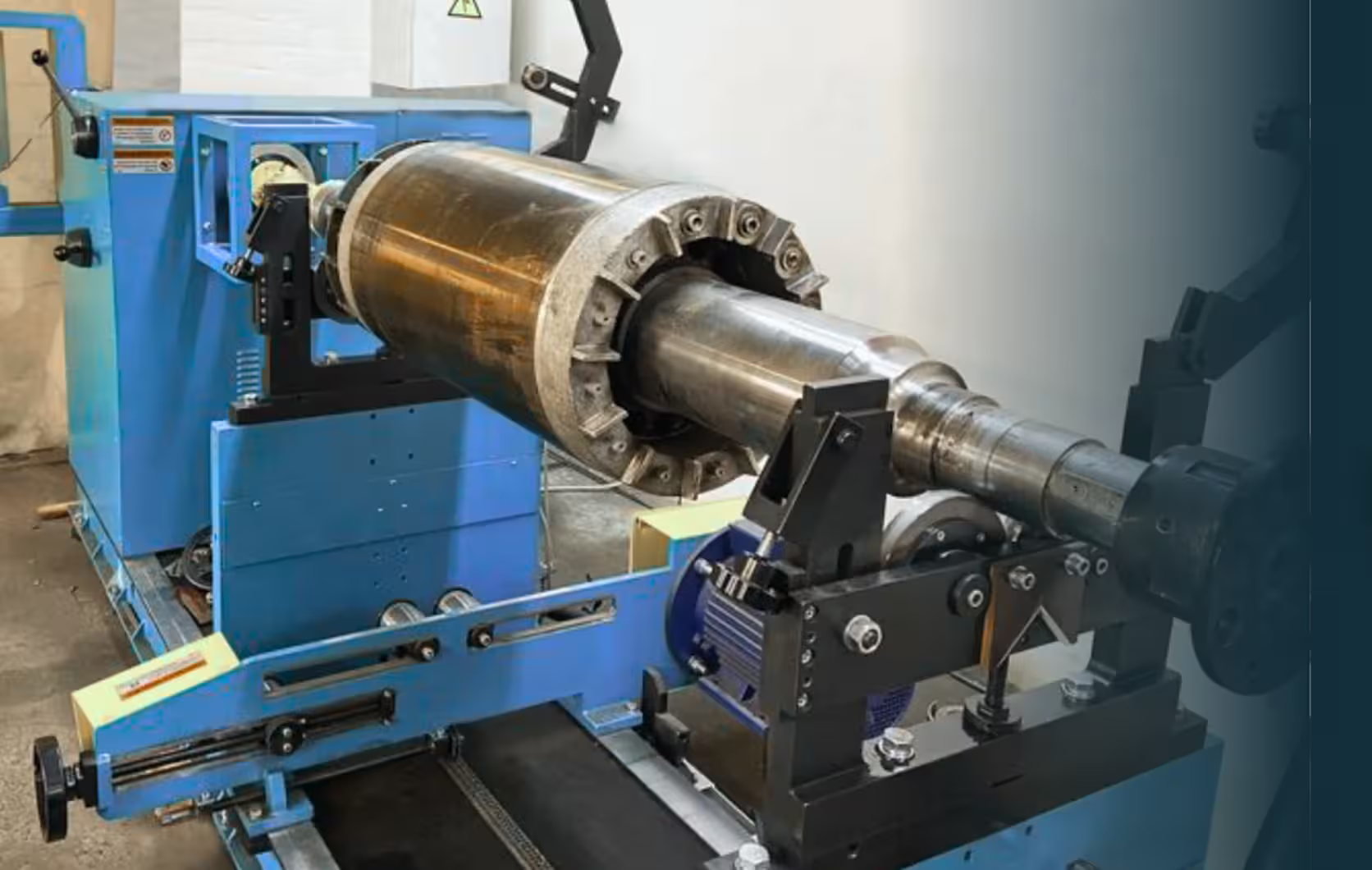
Dynamic balancing involves adjusting the mass distribution of rotating components such as fans or rotors to eliminate imbalance while they are running at operational speed. Is there intense vibration in your equipment while they run, especially in bearing housings or machine frames? Well, this is a classic sign of dynamic unbalance in machinery. The abnormal vibration levels that increase with rotational speed are a key clue indicating machine unbalance.
So, if you notice an increasing vibration frequency with rotor speed, or if vibration is mostly radial in direction, this could indicate a dynamic unbalance that needs attention. What is dynamic balancing? Dynamic Balancing, in simple words, is a technique to balance an unbalanced machine, a rotating component or equipment.
It is the process used to correct unbalanced rotors and machine components, substantially reducing noise and vibration and improving the quality and service life of machinery. The unbalances seen are generally due to uneven distribution of mass around the rotational axis, and the correction is usually done by adding or removing weight to restore balance. So, the rotating parts are run at high speed to record the actual measurement of the unbalance in each rotating component.
Dynamic Balancing becomes necessary when the rotating parts are unstable or when their original mass distribution is disturbed. Common factors that cause these issues are manufacturing errors, such as uneven material density or faulty machining levels, wear and tear from prolonged working, dirt or dust buildup, improper assembly and component damage, such as bent shafts or cracked blades, all of which lead to unbalance.
Any change in the operating speed or load conditions can add even more tension on the rotating parts, making dynamic balancing an essential maintenance practice to maintain smooth performance, reduced vibration and longer service life.

How Acoustic Emission Testing (AET) Detects Material Defects
Vibration Sensors for Industrial Condition Monitoring: Types, Applications, and Benefits

Partial Discharge (PD) Testing: A Practical Q&A Guide

How Industrial Machines are Balanced in the UAE?
What Is Shaft Alignment and Its Role in Equipment Reliability

Preventive Maintenance Solutions for Long-Term Asset Performance
A Complete Guide To Earth Pit Testing: Importance, Methods, And Standards
What is Dynamic Balancing?
Dynamic Balancing is basically the process of fixing unbalanced rotors so they can spin smoothly without unwanted vibration or instability during running. It is a critical maintenance technique that ensures the rotating equipment runs efficiently at its intended speed.
Normally, during this process, the machine under analysis is set to run under normal working conditions, to measure for any unbalances and then correct them by adding or removing weight at specified points on the rotating component. This correction can be carried out onsite or in a specialised balancing facility, depending on the size, conditions and practicality.
So, at its core, dynamic balancing properly addresses the uneven mass distribution around a rotor’s axis, because when the mass is not evenly distributed, it generates forces during operation that cause vibration, unpleasant noise and potential equipment and component damage.
Dynamic unbalances arise from uneven mass distribution in rotating parts, and these are mainly due to any of the following reasons: Manufacturing tolerances, material inconsistencies, improper assembly, corrosion, dirt build-up, wear and tear or component damage. Dynamic Balancing is generally classified into static unbalance, couple unbalance and combined unbalance. Understanding each unbalance is important to adopt the right strategy and to ensure precision balancing process.
Types of Unbalances
Rotating parts of machines can have various types of unbalances, purely depending on how their mass is distributed relative to the axes of rotation. SO, understanding these types of imbalances helps in choosing the right balancing methods and strategies to ensure smooth and hassle-free operations. The following are the most common types of rotating machinery unbalance
Static unbalance:
The unbalance occurs when the rotor's centre of gravity is offset from the rotational axis, or when the unbalance is equally distributed on the same side of the rotor, with the principal inertia axis parallel to the rotating centreline. It is the most basic form of unbalance. It is called static because this type of unbalance is present even when the rotor is not operational, that is, at static.
Static balancing is essential to prevent an object from rolling. When an object’s centre of gravity is on its rotational axis, it stays balanced, but if the centre of gravity is offset from the axis, the object becomes unbalanced and may rotate or roll. In static unbalance, the problem is usually one-directional, which means that there is just one dominant heavy spot that settles at the bottom and can be corrected in a single plane.
Couple Unbalance
Couple Unbalance occurs when two equal unbalanced masses are positioned at a rotor's opposite ends, spaced equally from the centre of gravity, but seen 180° apart in different planes. In this type of unbalance, the centre of gravity might still be on the axis of rotation, which means, unlike static unbalance, there is no single heavy spot.
However, the mass distribution creates a couple effect, where opposite forces act simultaneously at different locations along the shaft and create a rocking effect. Couple unbalance correction might need adjustments in at least two planes, usually by the ends of the rotor. By adding or removing weight in these planes, the opposing forces can be neutralised, ensuring smooth and stable running.
Dynamic unbalance
Dynamic unbalance is when a rotor shows the signs of both static and couple unbalance, making it the most common type of unbalance in real industrial settings, affecting the rotating machinery. Dynamic unbalance occurs due to uneven mass distribution along the rotor and not just at a single point.
In this condition, the centre of gravity would not align with the axis of rotation, and the principal inertia axis does not intersect and is not parallel to the shaft centreline. Because of this, the rotor faces both radial force and a wobbling sensation while running. This may also create intense vibration. Since in a real situation, imbalances exist as different small mass variations throughout the shaft, this can be said as two equivalent unbalances in different planes.
Dynamic unbalance can be found when the rotor is spinning, which is why the name ‘dynamic unbalance’. Usually, correction involves adding weights or removing them while the rotor is rotating to align with the axis. This requires balancing in at least two planes to attain smooth and stable operations.
Static Balancing and Dynamic Balancing
1. Static Balancing (Knife edging)
is carried out by placing the rotor on low-friction supports, which allows the heavy spot to naturally settle at the bottom thanks to gravity. Material is then removed from the heavy side or added to the lighter side until the rotor no longer rotates on its own and remains stationary in any position. This process is repeated until the mass is evenly distributed and the rotor achieves true balance.
2. Dynamic Balancing (single & multiplane)
is done by measuring the rotor’s unbalance while it is rotating at a predetermined speed using specialised tools. Based on this data, weights are added or removed in appropriate locations to counteract heavy or light spots, reducing vibration and noise. The process is repeated until rotation produces minimal centrifugal forces, ensuring smooth operation and preventing any premature equipment damage.
Static Vs Dynamic Balancing
Depending on how mass is distributed along the rotor, balancing is categorized into static and dynamic balancing methods. Static balancing focuses on an imbalance in a single plane, while dynamic balancing deals with more complex conditions involving multiple planes and motion effects.
Aspect
Static Balancing
Dynamic Balancing
Definition
Balancing done to correct unbalance in a single plane
Balancing done to correct unbalance in multiple planes
Type of Unbalance
Static unbalance (single heavy spot)
Dynamic unbalance (combination of static + couple)
Mass Distribution
Concentrated at one point
Spread along the rotor length
Rotor Condition
Can be balanced without rotation
Must be balanced while rotating
Motion Produced
No wobbling, only radial force
Radial + tilting (wobbling) motion
Detection
Identified in a stationary condition
R Detected using special instruments while in rotation
Correction Method
Adding/removing weight in one plane
Adding/removing weight in two or more planes
Complexity
Simple
More complex
Applications
Short, narrow rotors (e.g., discs, wheels)
Long rotors (e.g., shafts, turbines, fans)
Dynamic Balancing types
Dynamic balancing can be performed on components of various shapes and sizes:.
Single plane
Single plane dynamic balancing is carried out at a comparatively low speed and narrow disks with a width less than 30% of the diameter.
Multi Plane
Multi-plane dynamic balancing is carried out on components that run at higher speeds and where the width is more than 30% of the diameter.
Why do you need Dynamic Balancing?
To remove vibration in rotating machinery entirely is not realistic, but controlling it to an acceptable level is possible and essential to ensure hassle-free and efficient operation. Here is where dynamic balancing comes into the spotlight. Dynamic balancing focuses on reducing vibration by fixing mass distribution, helping the machines run more steadily and stably with reduced noise. By achieving a proper balance, industries can improve their performance and asset reliability. With dynamic balancing, both are possible. Here are some benefits of Dynamic Balancing:
Benefits of Dynamic Balancing
- Reduces vibration and noise levels
- Improves machine efficiency and performance
- Extends equipment life
- Minimises wear on bearings and components
- Prevents premature failures and breakdowns
- Reduces maintenance costs and downtime
- Enhances overall operational reliability
Terms Associated with Machinery Balancing
Brake Balancing: explained
Brake balancing is the process of correcting the mass distribution in a rotating brake component, like discs or drums, so that they can rotate without any vibration, noise, or uneven wear. Break components operate at high speeds and are very pivotal to safety; even a small imbalance can lead to operational issues, reducing component life and fatigue while in operation. Balancing is normally achieved by adding or removing material so that the mass is evenly distributed around the axis of rotation.
What Are Balancing Limits?
Balancing limits are the acceptable level of residual unbalance that can stay within the component after a balancing process. The limits are normally established by standards such as those from the ISO, which provide guidelines and specify balance quality grades depending on the type and operating conditions of the machine. Balancing limits make sure that the vibration levels are within the safe and operational ranges, thus preventing excessive stress on bearings and other related parts. So, in short, balancing limits provide a benchmark that determines how well a balancing process needs to be for a dependable and efficient industrial operation.
Types of Rotors
In machinery, the rotors are the rotating part of the equipment that spins around the central axis for transmitting energy, fluid flow or even motion. They are really a staple factor in the operations of industrial equipment, for instance, motors, pumps, compressors and fans. As we all know, rotors that operate at quite high speeds are responsible for the power transmission and their condition has a direct impact on machinery performance, reliability and overall efficiency.
Rotors are critical because any problem in their mass distribution or positioning can lead to intense vibration, noise and early wear. A properly aligned and balanced rotor means a smooth operation, reduced stress on bearings and seals and a prolonged asset lifespan; all in favour of improved reliability and operational efficiency. The common types of rotors are:
1. Rigid Rotors: These are rotors that may not largely deform under different operating speeds. Their centre of mass stays constant, which makes them comparatively easy to balance. Several small to medium sized machinery, such as electric motors and pumps, use rigid rotors.
2. Flexible Rotors: These are long rotors that run at very high speeds, that cause them to deflect or bend while rotating. As they rotate at critical speeds, they require advanced balancing techniques.
3. Overhung Rotors: In these rotors, the mass is seen outside the supporting bearings. These types of rotors are seen in blowers, fans and in some pumps.
4. Between-Bearing Rotors: These rotors are supported by bearings on both sides, with the rotating mass located between them. It provides improved stability and is largely used in heavy industries for machinery such as turbines and large motors.
Why Rotors Matter in Alignment and Balancing
Rotor performance is directly correlated to machine alignment and vibration patterns. A small misalignment between coupled rotors or uneven mass distribution can create significant dynamics while in operation. This can lead to:
- Increased vibration levels
- Energy losses
- Bearing and seal failures
- Reduced machine lifespan
Proper alignment ensures that connected rotors share a common centreline, while dynamic balancing corrects mass distribution to eliminate vibration. Together, these practices help maintain optimal rotor performance and overall machinery health.
Dynamic Balancing in the UAE with ACM
AssetConditionMonitoring.com, a leading condition monitoring and asset reliability service provider in the UAE powered by Technomax, delivers robust and reliable dynamic balancing solutions, along with services such as vibration analysis, laser shaft alignment, and a wide range of other condition monitoring solutions.
We ensure proper upkeep and maintenance of your rotating components. With Assetconditionmoniroting.com, industries can rely on precise and professional Dynamic Balancing Solutions aligned to their specific demands.
ACM focuses on giving the best, high-quality services, meeting every demand of critical machinery requirements. This, plus the expertise of our skilled engineers, equals all-around efficiency.
Why choose us?
1. Precision Balancing: Accurate identification and correction of imbalance.
2. On-Site Services: Proper and thorough field balancing to minimise downtime and remove the need for dismantling equipment.
3. Comprehensive Diagnostics: Detailed vibration analysis to detect any underlying issues.
4. Standards Compliance: Services that match international balancing standards such as ISO guidelines.