

What is Partial Discharge Testing?
What Types of Motor Faults Can MCSA Detect?
Gearbox Vibration Analysis: How To Find Gear Faults Through Vibration Signals

Construction Vibration And Noise Monitoring UAE

What Is Pump Cavitation and How to Avoid It
Why Pump Alignment Is Critical for Reliable Industrial Operations ?
How Does an Acoustic Camera Work?
What is Infrared Thermography for Electrical Inspection?
How FEA Analysis Improves Structural Performance & Reliability?
What is Dynamic Balancing: Why It Matters in Industrial Equipment
How Acoustic Emission Testing (AET) Detects Material Defects
Partial Discharge (PD) Testing is a non-invasive diagnostic method used to detect weaknesses, electrical discharges or tiny sparks from inside the insulation systems of critical electrical assets such as transformers, motors, generators, cables, switchgear and GIS systems. In simple terms, if there are tiny air gaps, cracks, moisture or any weak spots inside the insulation and when high voltage is passed through, minute sparks occur in these compromised areas. These miniature sparks are called Partial Discharge.
Although these discharges may be small, continuous PD slowly damages and weakens the insulation and can cause electrical breakdowns, arc flashes, equipment failure, and fire hazards. So, proper diagnosis and detection of these weak spots before they turn into catastrophic issues are imperative. There are several techniques and devices to conduct PD. The tests can be done online as well as offline (de-energised) using sensors like TEV (Transient Earth Voltage), UHF, HFCT and more.
AssetConditionMonitoring.com, powered by Technomax Middle East, offers advanced PD testing services in UAE and Middle East regions with the most modern measurement technologies customised to multiple PD testing applications. AssetConditionMonitoring.com boasts online testing methods that are avant-garde, non-invasive and non-destructive, making them ideal for precise PD testing with the latest tools and comprehensive condition monitoring solutions across industries.
Partial Discharge monitoring and testing are carried out without interrupting routine operations, a wide variety of electrical assets from 3kV to 700kV and above can be easily evaluated using online PD testing.
Where can Partial Discharge Occur?
Partial Discharge (PD) can occur in almost any electrical insulation system, especially where the electric stress exceeds the insulation strength locally without entirely bridging the electrodes. Usually, PD occurs inside insulation voids, cracks, air gaps, or on contaminated insulation systems in high-voltage equipment such as transformers, motors, generators, switchgear, cables and GIS (gas-insulated substations) systems.
PD may look minute in the beginning, but continuous PD activity gradually weakens the insulation material through heat, chemical reactions and erosion. Eventually, the insulation collapses, leading to fire risks, equipment damage and more. The following are the common locations of PD activity:
- In insulation mediums (Air, Oil, Solid, GIS).
- Voltage classes ranging from 3 kV up to 769 kV and higher.
- In both indoor and outdoor metal-enclosed switchgear panels.
- Found in indoor as well as outdoor insulators.
- In power and distribution transformers.
- In transformer cable termination boxes.
- SF6 gas-insulated, oil-insulated, and air-insulated equipment systems.
- In medium-voltage (MV) and high-voltage (HV) cable systems.
What are the Types of Partial Discharge?
Partial Discharge can occur in different ways, largely depending on the location and condition of the insulation system. The most common types of PD include:
- Internal PD occurring inside air voids, cracks inside power cables, motors etc.
- Surface PD due to moisture, dirt or soiling in bushings, insulators and cable terminations.
- Corona discharge occurring in the air around high-voltage conductors is commonly seen in overhead transmission lines and HV connectors.
- PD in cable joints and transformer insulation systems is subject to uneven electrical stress between insulation layers.
- PD in GIS if contaminants or defects are present.
- In rotating machines like motors and generators, insulation in the winding is prone to PD.
How to Analyse Partial Discharge?
Partial Discharge analysis is done by studying minute electrical discharges that happen inside or on the surface of insulation. PD Pulses, their magnitude, phase position, frequency and pattern are thoroughly analysed; the main goal is to see if the insulation inside the equipment is healthy or if there is a defect developing.
The PD signal is captured, amplified, digitised and processed using filters. In modern Partial Discharge (PD) measurement systems, the PD signal is first amplified using a pre-amplifier, which is then converted into digital mode through an analog-to-digital converter. After digitising, the signal is processed using digital filters, digital detection methods and computer-based analysis.
As most of the PD processing is done digitally, the data received will be accurate and likely repeatable. Unlike traditional analog systems, digital systems are less prone to changes in time, temperature, or component ageing.
The analysis mainly aims at checking the following points:
- PD Magnitude, showing the strength of discharge.
- Phase Position to know the type of defect by checking the point at which PD occurs.
- PD Pattern aids in diagnosis, where PD charges are plotted as a pattern.
- Repetition Rate, showing the frequency of PD activity. A high repetition rate indicates insulation deterioration.
- Trends Over Time, increasing PD level shows insulation weakening.
- Noise Separation to avoid false readings from other sources.
How to Measure Partial Discharge?
Generally, PD measuring is done by connecting an appropriate PD sensor or coupling device to the electrical equipment. At first, a test voltage is applied, and any small discharge pulses produced inside or on the surface of the insulation are detected. These advanced vibration sensors and tools record and analyse the readings to understand the condition of the insulation. The following are the steps involved:
Prepare the test equipment: At first, the equipment to be tested is isolated, de-energised if required, made safe and ready for testing.
Connect to the PD measuring system: the test subject is then connected to the PD sensor or coupling device. Normally, coupling capacitors, TEV, UHF, or acoustic sensors are used, depending on the equipment type.
Test Voltage is given: A pre-decided suitable AC voltage is applied at first and then gradually increased to see PD in a weak or defective spot inside the insulation.
PD signal detection: PD discharge produced is captured by sensors and sent to the measuring instrument. These signals are amplified and converted into digital form.
Noise Filtration: Unwanted noise from external sources, like radio signals, or from other devices, is filtered and removed to separate PD activity.
Measuring PD: The PD detecting system records the amplitude of PD pulses, and the PD pulses are compared to identify the defect type.
PD Pattern: The readings are displayed as a pattern; different faults produce different patterns.
Recording and Evaluation: PD intensity, Phase pattern, and trends are recorded. Increasing PD levels indicate insulation deterioration.
By analysing these results, the condition of the insulation can be assessed and early defects can be identified before major failure occurs, making it effective in tackling PD issues.
What online partial discharge testing techniques are available?
Detecting Partial Discharge (PD) in medium and high voltage electrical equipment can be tricky and requires careful attention. To make this process easier and avoid interrupting the power supply, the best approach is to use advanced sensors and tools that can capture signals at various frequencies. This combination of technology helps ensure that no PD pulses are missed, leading to more accurate detection. By using these tools, we can improve the safety and reliability of electrical systems.
- Ultrasonic System
- TEV
- UHF
- HFCT/RFCT
Integrated Partial Discharge Solutions
AssetConditionMonitoring’s Integrated Partial Discharge Testing and Monitoring Solutions are a suite of advanced tools, combining online and offline testing as well as periodic and continuous electrical assets health monitoring. AssetConditionMonitoring.com adopts strategic and effective ways to customise a PD system that suits your needs. We offers the following comprehensive services, which you can choose from:
- Online PD Testing
- Continuous Online Monitoring
- Remote PD testing
- Handheld-compact sensors
- Periodic PD testing
- Ultrasound Analysis
- Offline PD testing
- Tan Delta
- Very Low Frequency (VLF)
Tools Used for Partial Discharge Testing
PD Instruments / Spot Testers
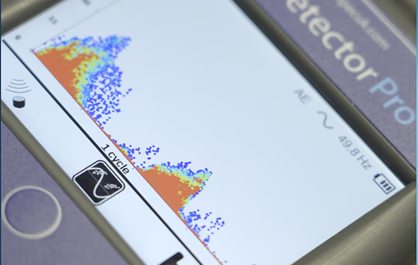
PD Detector Pro - Next-Gen Handheld PD Testing
Precise, user-friendly spot testing for MV/HV assets with advanced noise rejection, clear touchscreen analysis, and wide sensor compatibility.
PD Detector On-line Partial Discharge Spot Testing for HV Assets
The PD Detector is a portable, online PD spot tester designed for high-voltage (HV) assets.
PrecisePD
PrecisePD is an on-line Partial Discharge Spot Testing and Location tracking System for Cables and Switchgear with advanced signal processing.
PD-SG1
The PD-SG1 is a dual transducer switchgear PD testing instrument. The unit detects PD signals generated by internal discharges.
PD Monitoring systems
ASM Permanent PD Monitor
ASM is a permanent PD monitor suitable for cables, switchgear, and other high-voltage assets, configurable for multiple sensor channels.
ASM-Portable - Portable PD Monitor
ASM-Portable is a portable PD monitor for cables, switchgear, and other HV assets, and forms part of IPEC's on-line PD monitoring range.
DeCIFer – PD Noise Cancelling
There are multiple factors that affect the precision of on-line partial discharge detection including sensitivity of sensors, rate and noise performance.
PD Sensors
VDS - PD Detector Pro
IPEC's compact VDS sensor measures the presence and severity of partial discharge activity within air- or gas-insulated switchgear.
CC-TEV
The CC-TEV capacitive coupler detects TEVs as they pass over the cladding of the high voltage plant.
AA-Ultrasonic
The AA Ultrasonic acoustic probe is specifically used on air insulated terminations where a clear sound path exists between the electrically active area and the sensor.
HFCT
The HFCT is a high frequency current transformer designed specially for picking up PD signals.
UHF
IPEC's UHF sensors are used to detect PD in EHV cable terminations and GIS.
Noise Gating
When PD signals occur within GIS assets, the ultra-high frequency signal emitted can be detected by dedicated UHF sensors.
Environment Sensor
The temperature and humidity sensor generates frequency-modulated signals on two output channels.
Parabolic Reflector
The Parabolic Reflector is an ultrasonic sensor to detect partial discharge activity on exposed insulating surfaces.
Flexible AA Probe
Flexible AA Ultrasonic Probe is an accessory to IPEC's partial discharge spot testing instruments.
Contact AA
The Contact Acoustic Sensor is mainly used for oil-filled transformers, circuit breakers and other plant.
UHF-E
The embedded UHF PD sensor is designed for special applications and can be positioned in a cable termination box or at other locations.
Partial Discharge Testing Services In UAE With AssetConditionMonitoring.Com
AssetConditionMonitoring.com offers advanced online and offline Partial Discharge Testing solutions, incorporating the latest tools and technologies for accurate electrical inspection and monitoring and to spot even minor PD activity in your electrical assets. Our expert technicians provide partial discharge monitoring, ensuring local support from installation to ongoing technical assistance specific to your needs.
Reach out to us and explore our comprehensive partial discharge Monitoring services to protect your electrical infrastructure. We provide expert assistance in condition monitoring services, insulation resistance testing, PD testing. Our PD testing showcase:
1. Regular routine online PD spot testing of switchgear, transformers and cable systems.
2. Continuous condition monitoring in challenging industrial settings
3. Preventive maintenance strategies to mitigate risks, ensure asset reliability and insulation protection.