
How partial discharge affects Insulation performance
What Types of Motor Faults Can MCSA Detect?
Gearbox Vibration Analysis: How To Find Gear Faults Through Vibration Signals

Construction Vibration And Noise Monitoring UAE

What Is Pump Cavitation and How to Avoid It
Why Pump Alignment Is Critical for Reliable Industrial Operations ?
How Does an Acoustic Camera Work?
What is Infrared Thermography for Electrical Inspection?
What is Partial Discharge Testing?
How FEA Analysis Improves Structural Performance & Reliability?
What is Dynamic Balancing: Why It Matters in Industrial Equipment
Partial discharge (PD) is a localized electrical discharge that occurs within or along the surface of electrical insulation when the insulation system is subjected to high electrical stress. Although each discharge is typically small and may not cause immediate insulation failure, repeated partial discharge activity can progressively degrade insulation and reduce the reliability of critical electrical equipment.
Over time, PD can create thermal, chemical, and mechanical damage within the insulation system, leading to erosion, carbonization, electrical treeing, and the formation of insulation defects. If left undetected, these defects can develop into insulation breakdown, unplanned equipment failure, costly repairs, and production downtime.
Understanding how partial discharge affects insulation performance is therefore essential for condition monitoring and preventive maintenance of high-voltage assets such as transformers, switchgear, generators, motors, cables, and other electrical equipment. Partial discharge testing and monitoring can help identify insulation defects at an early stage, assess their severity, and support condition-based maintenance decisions before a critical failure occurs.
Electrical insulation is a robust barrier that stands between unwanted current and conducting parts and is an indispensable part of electrical and electronic components. Insulation health monitoring is critical because the safety and reliable operation of critical machinery and personnel depend on it. Ensuring safety is paramount, and the efficient operation of electrical systems should not be taken lightly. This is why insulation quality must be regularly inspected and maintained.
How does Partial Discharge occur?
Partial Discharge (PD) is a limited electrical discharge that can occur within an insulation system when the local electric field becomes way stronger than the dielectric strength of the material, without entirely bridging the insulation between the energised electrodes. It commonly starts in internal voids, cracks, delaminated layers, surface imperfections, or at interfaces between a variety of insulation materials.
These weak points can create areas where the electric field becomes concentrated. When the electrical stress becomes high enough, the gas or weakened area within the insulation can ionise and produce a short-duration discharge. While each PD might only generate a small amount of energy, as this is repeated, these repeated discharges can gradually damage the surrounding insulation and eventually lead to insulation breakdown.
PD can develop due to manufacturing defects, poor bonding, moisture ingress, contamination, thermal and electrical ageing, mechanical stress, or prolonged exposure to harsh environmental conditions. Depending on where and how it occurs, PD can take different forms, including internal discharge, surface discharge, and corona discharge, with each producing different electrical, acoustic, electromagnetic, or chemical signals.
As PD continues, it can cause localised heating, chemical changes, carbonisation, and physical damage to the insulation, which further accelerates the ageing process. This is why PD measurement and condition monitoring are important for identifying insulation defects at an early stage, understanding their development, and taking corrective action before they result in complete electrical failure.
How Does Partial Discharge Damage Electrical Insulation?
Partial Discharge can, over time, weaken the electrical insulation and affect the entire reliability and safety of electrical equipment. Even though PD activity could be localised and are usually small, repeated discharge and continuous stress can damage the insulation, causing erosion, heating, chemical changes and weak or conductive paths to form. If this condition is left unaddressed and allowed to escalate, it can eventually result in complete insulation collapse, leading to partial or whole equipment damage, sudden operational disruption, costly downtime and various safety hazards.
Furthermore, the aftermath of PD is not just limited to insulation failure alone, as insulation degrades and deteriorates gradually, the affected equipment become less reliable and would need frequent inspection, testing, and maintenance. In critical electrical systems, an undetected insulation defect can also increase the risk of service interruptions and secondary equipment damage. Regular PD testing and condition monitoring is essential to identify these problems early, which allows the industries to adopt corrective action before a minor insulation defect becomes a major failure.
Why Is Partial Discharge Testing Crucial for Asset Management?
What may seem like a minor issue, could escalate and become catastrophic affecting multilevels of operations. PD might appear small in the beginning but leaving it unaddressed or overlooked can cause serious concerns. Regular PD testing is integral to safeguard electrical assets and should be a part of the strategic asset management process because it helps assess the condition of electrical insulation without waiting for imminent failure.
PD activity can mean developing insulation defects that may not be visible during a routine inspection, giving maintenance teams an early indication that an asset may be deteriorating. For critical electrical assets like transformers, switchgear, cables, motors, and generators, early detection can make huge differences.
By detecting, tracking and monitoring PD levels, the industries can identify variation in insulation condition, be prepared for an emergency, plan maintenance based on the actual condition of the equipment. All of which is essential to prevent unexpected failure, unplanned shutdowns, and extend asset service life.
From the point of asset condition monitoring, regular monitoring and maintenance of PD aids in condition-based maintenance where decisions are based on the actual condition of the asset rather than fixed maintenance intervals. So, in the nutshell, Partial Discharge testing helps detect developing insulation defects before they become serious failures, allowing maintenance to be planned around the actual condition of the equipment. It helps reduce unexpected downtime, emergency repairs, and unnecessary replacement costs while supporting better decisions on repair, replacement, and asset life.
PD testing can also be carried out during Factory Acceptance Testing (FAT) and Site Acceptance Testing (SAT) to check insulation condition before equipment is put into service.
High-Frequency Current Transformer Testing
High-Frequency Current Transformer (HFCT) is a specialised testing to detect the fast electrical pulses produced by Partial Discharge and other high-frequency signals travelling through a cable or conductor. The HFCT sensor is normally clamped around a grounded cable screen, earth lead, or bonding connection, making it a convenient and practical method for checking cable systems without directly getting in contact with the high-voltage conductor.
HFCT testing can be very useful because by using sensors at different points along the cable system, the signals can be easily compared to help understand where the actual discharge is coming from. This makes the method particularly useful for inspecting long cable runs, joints, and terminations, where identifying the location of a developing insulation defect is important.
UHF, TEV, and Acoustic Detection
Ultra-High-frequency (UHF) is a detection method to find electromagnetic signals generated by PD at extremely high-frequencies. It is usually commonly put to application in equipment like Gas-Insulated Switchgear (GIS) and transformers, where the enclosed design helps capture the signals and reduces interruptions caused by external electrical noise. UHF testing can provide good sensitivity to PD activity and, when several sensors are used, can also get the approximate location of the discharge source.
The signal picked by a UHF sensor can vary and it depends on the equipment design,internal components, sensor position and the electromagnetic wave path. Which means, a weak signal does not always mean that the PD activity is trivial, as the source may be far from the sensor or the signal may experience attenuation while travelling through the equipment.
Transient Earth Voltage (TEV) detection is mainly used for understanding metal-enclosed switchgear. When PD occurs inside the enclosure, it produces short-life electromagnetic pulses that can travel to the outer surface of the metal enclosure. A TEV sensor can detect these pulses. This allows testing to be carried out with minimal interference to the equipment. But, the results can be influenced by the construction of the enclosure, the position of the defect, and how easily the generated signal can reach the accessible surfaces.
Acoustic PD testing picks up the sound or pressure waves produced when a PD activity occurs inside electrical equipment. It is commonly used along with other PD measurement methods for transformers, switchgear, and other large electrical assets. Acoustic sensors can help locate the area where the discharge is happening and are generally less sensitive to electromagnetic interference.
But an issue concerning acoustic PD testing is that the signal can become weaker as it travels through oil, insulation, metal surfaces, joints, and other internal structures, which makes the acoustic method not very reliable if done alone. For more reliable results, acoustic measurements are often compared with an electrical PD signal to confirm the source and improve the accuracy of defect location.
How Can Organisations Implement Effective Partial Discharge Monitoring?
Effective Partial Discharge monitoring needs a structured approach that makes use of the right testing method with regular measurements and proper analysis. By continuously assessing insulation condition and tracking changes in PD activity, industries can identify developing defects early and intervene promptly to protect critical electrical assets.
Acoustic PD testing identifies the sound or pressure waves produced when a Partial Discharge event occurs inside electrical equipment. It is commonly used along with other PD measurement methods for transformers, switchgear, and other large electrical assets. Acoustic sensors can help locate the area where the discharge is occurring and are generally less sensitive to electromagnetic interference.
However, the signal can become weaker as it travels through oil, insulation, metal surfaces, joints, and other internal structures. For more reliable results, acoustic measurements are often compared with an electrical PD signal to confirm the source and improve the accuracy of defect location.
- 1.
Identify critical assets – Choose equipment where insulation failure could cause major downtime or safety risks.
- 2.
Select the right PD method – Select appropriate techniques like HFCT, UHF, TEV, acoustic, or other suitable techniques based on the equipment.
- 3.
Establish baseline readings – Record initial PD measurements to create a reference for future comparisons.
- 4.
Perform regular monitoring – Track PD activity periodically or continuously to track changes over time.
- 5.
Analyse and trend results – Evaluate PD patterns, intensity, and location to understand actual insulation condition.
- 6.
Plan corrective action – Schedule inspection, repair, or replacement based on the severity and progression of the defect.
Partial Discharge Testing Tools from IPEC
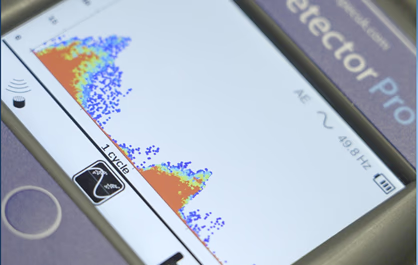
PD Detector Pro
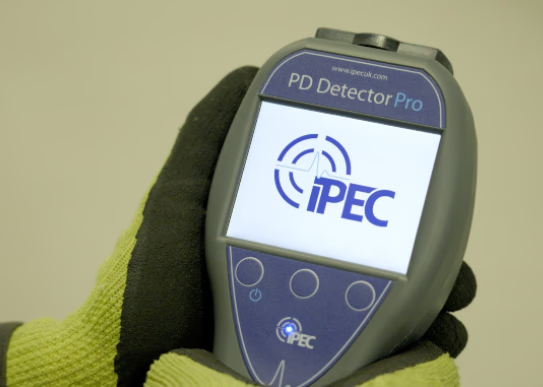
Accurate and easy-to-use spot testing for MV/HV assets, featuring an intuitive touchscreen interface and advanced noise filtering for reliable PD detection in challenging environments. Wide sensor compatibility provides flexible testing options across a range of electrical assets.
PD Detector - On-line Partial Discharge Spot Testing for HV Assets
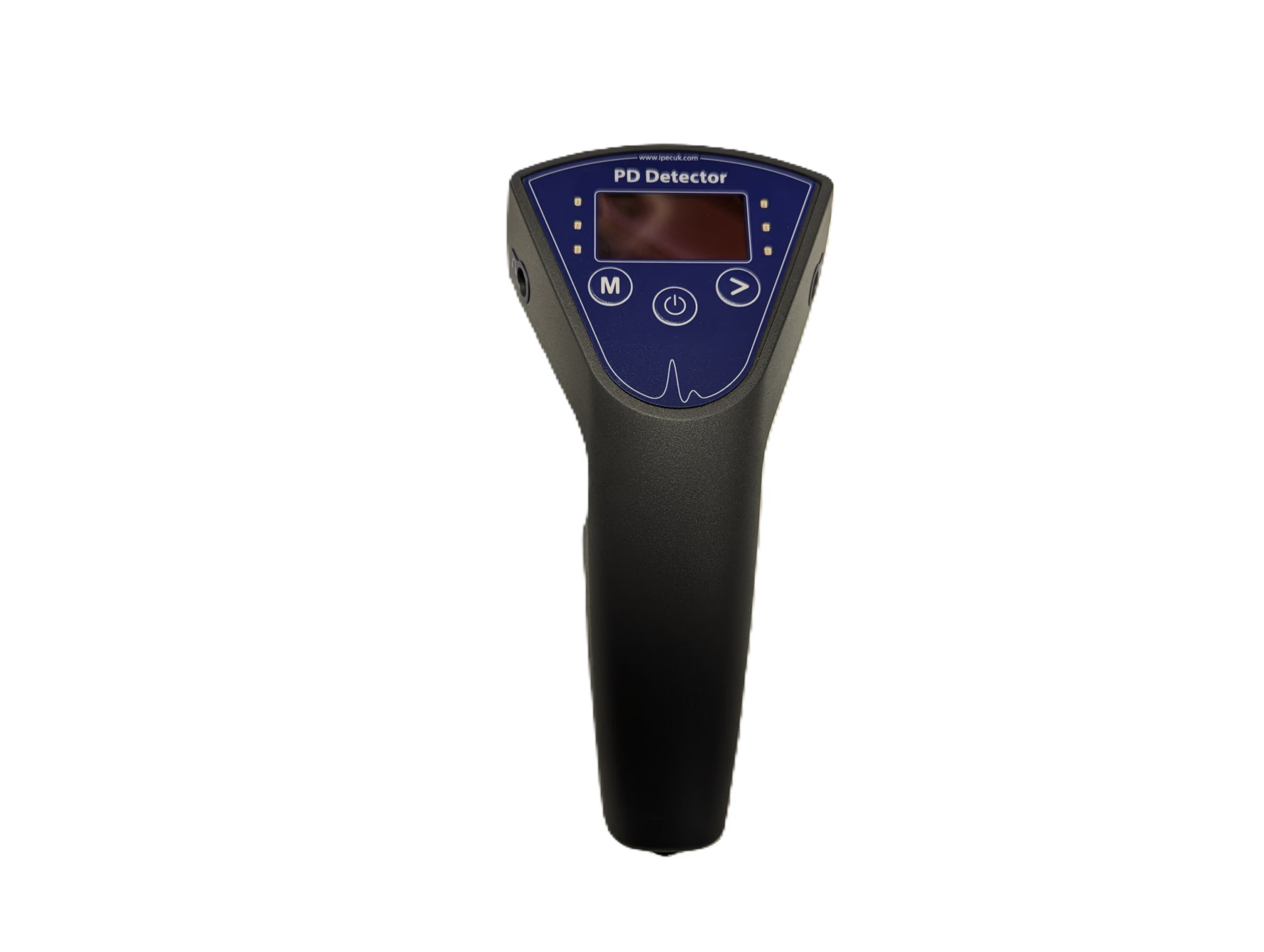
The PD Detector is a portable, online partial discharge spot tester for HV assets, enabling fast substation surveys and convenient PD assessment. It provides PRPD pattern analysis through the device or mobile app and uses advanced noise separation to support accurate detection in challenging environments.
PD-SG1:
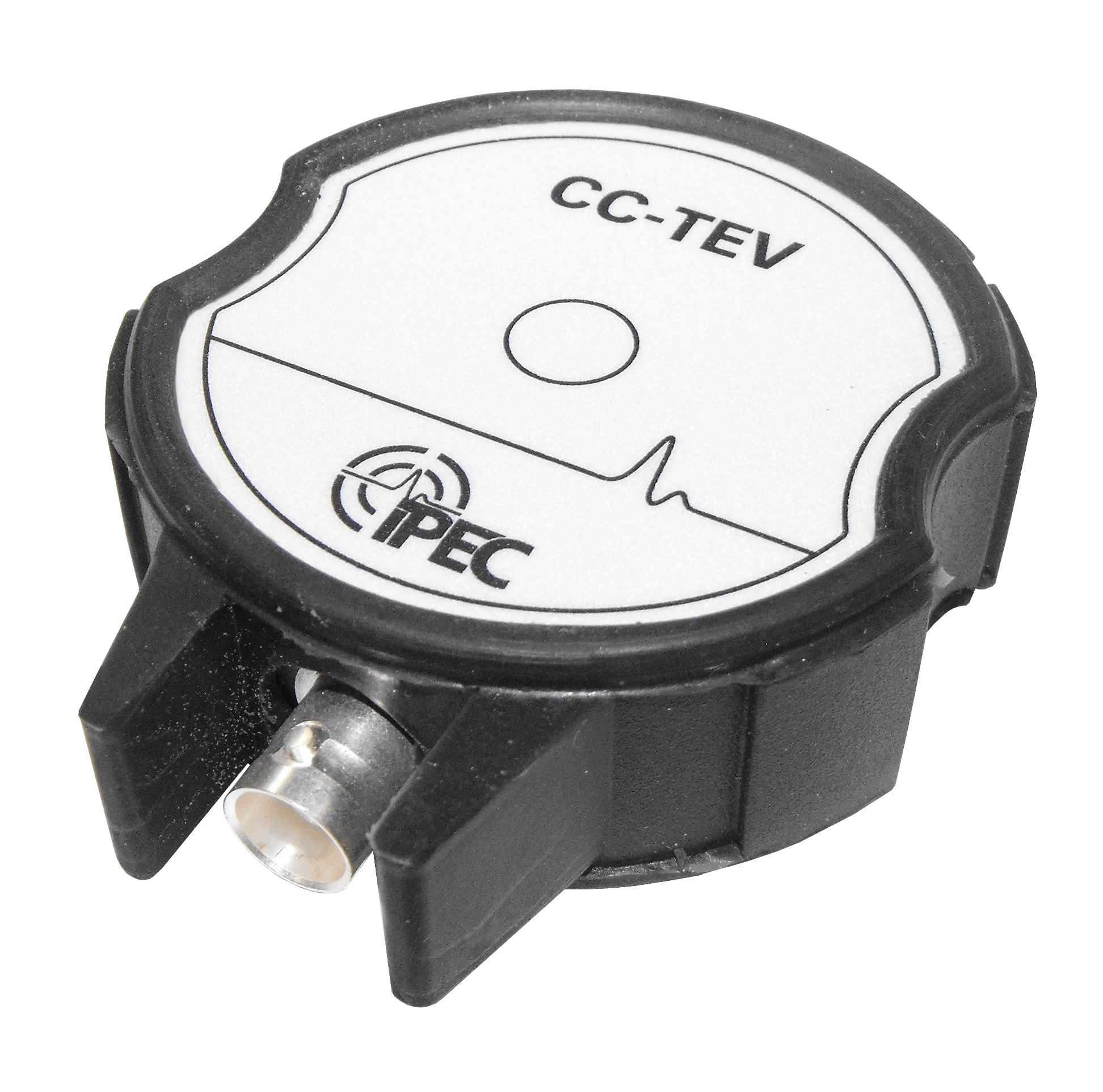
The PD-SG1 is a dual-transducer switchgear testing instrument designed to detect partial discharge signals from internal defects, while ultrasonic detection identifies surface PD activity and displays the measured level in dB on the LCD screen.
PrecisePD
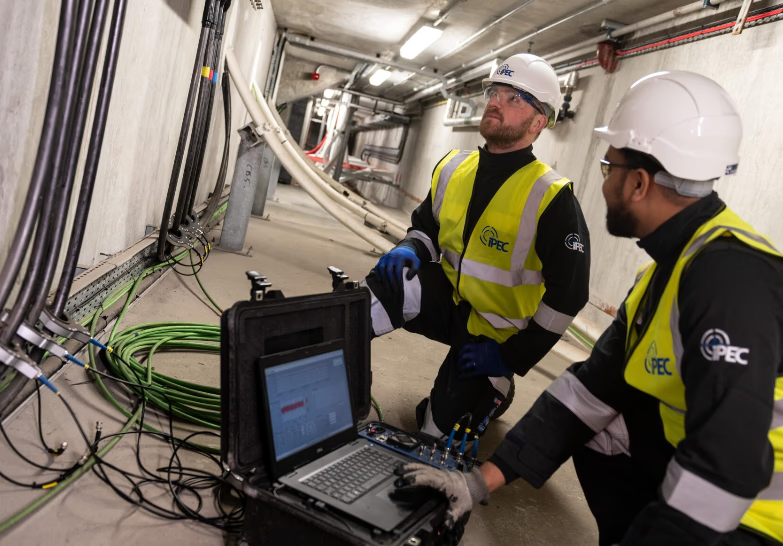
PrecisePD is an online partial discharge (PD) spot testing and fault location system designed for cables and switchgear. Its advanced signal-processing technology enables sensitive and reliable PD detection, even in electrically noisy environments.
ASM Permanent PD Monitor
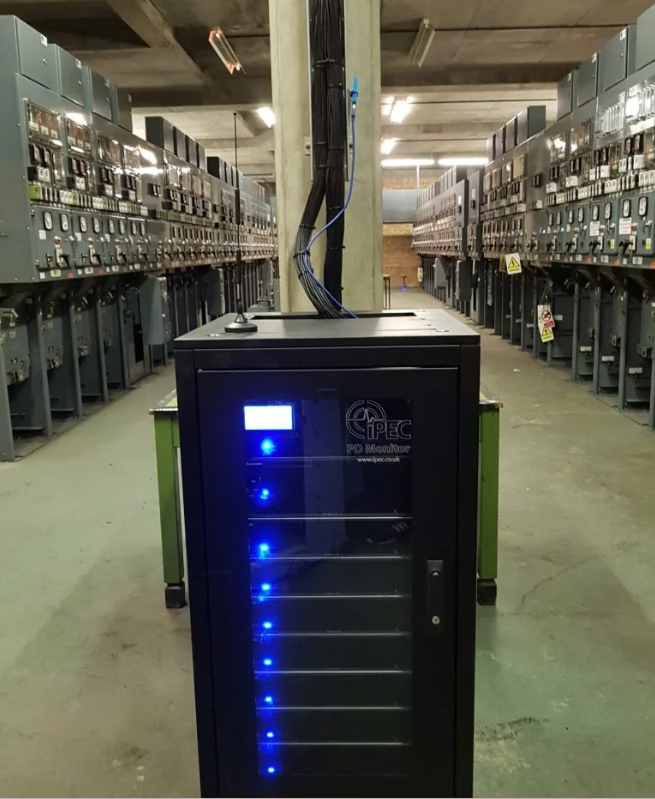
ASM is a permanent partial discharge monitoring system for cables, switchgear, and other HV assets, supporting multiple sensor channels, customizable cabinet configurations, and automatic data transfer to a central monitoring base.
Connect with us for reliable and efficient partial discharge testing tools designed to detect and assess insulation defects in high-voltage electrical equipment. Our solutions support accurate PD measurement, condition monitoring, and early fault detection to help improve asset reliability and prevent unexpected failures.
AssetConditionMonitoring.com- Your Trusted Partner for Partial Discharge & Asset Reliability Solutions in UAE and Middle East
With more than two decades of experience in partial discharge testing and asset condition monitoring services, ACM provides reliable solutions to help industries monitor, assess, and maintain critical electrical and mechanical assets. As a trusted partner of IPEC, we offer advanced partial discharge testing and monitoring technologies for cables, switchgear, and other high-voltage equipment.
Along with online Partial discharge testing services, our experienced engineering team delivers offline partial discharge measurement a complete range of condition monitoring and asset reliability solutions across the UAE and GCC. From predictive maintenance and vibration analysis to advanced asset monitoring, we combine the most modern technologies with practical engineering expertise to identify developing issues early and support informed maintenance decisions.
Partner with ACM for smarter monitoring and reliable asset performance. Contact our team today.